
Basics
Home and SearchSite Guide
Brentford Basics
Privacy Policy
Contact
People
FamiliesPhotos of people
Name indexes incl WW1
Memories
Lists, Documents, News
Occupations
Properties
Properties: High StreetProperties: non-High Street
Photos
Maps
1909/10 Valuation Index
Pub Hub
Can You Help?
Seeking...Mystery photos
Roads Off
A-Z listJanet's Research
HistoryBeach's Jam
Nowell Parr
Turner the Artist
Queen Victoria 1840
Brentford Market
80 High Street
Clitherow of Boston House
Four Croxford Brothers
Sources & More
They SaidBooks etc.
Web Links
Next
Site Technology
Author
Home and Search
Not Brentford
Bigamists with Brentford connections: Joseph Whitehead
With thanks to Lorraine Dicksee for her original research into bigamists with Brentford connections.
Background
Elsewhere on this website - in the Brentford families section - you will find some notes on the Whitehead family provided by Ann King. Ann references her great grandfather, Joseph Whitehead, telling us he was imprisoned after being convicted of bigamy. I am writing a series of stories on bigamists with Brentford connections so thought this was as good a place as any to start. It may be that once she has read my account, Ann will be able to fill in some of the gaps or offer up corrections to my version of the story. An attempt has been made to contact Ann but without success.
Reuben & Maria Whitehead were Suffolk people of the Wesleyan Methodist faith. They had eight children, all of them born in Suffolk, but it seems only two of the siblings ever left the county: Joseph born in 1825 and Benjamin born 1827.
Benjamin headed for Brentford to take up a career as a watchmaker following an apprenticeship back in Suffolk. He can be found in Brentford from about 1854, when he married Mary Lacey at St Mary Ealing, and at the time of the 1861 census the couple were living at 278 High Street, Brentford. After Mary died, Benjamin married widow Emma Murray (nee Seymour) in 1865 Bermondsey, Southwark, but they eventually returned to 278 High Street from around 1885. Benjamin died in Brentford in 1907 at the age of 80.
Joseph couldn't have been more different from his brother. There may be reasons why his love-life went wrong but it has proved impossible so far to find out who he married first, leaving us without any information about his life before his second (we think) marriage in 1856.
The 1841 census return shows Joseph still in Suffolk with his family, then in 1854 he was a witness at his brother's wedding in Ealing. So in addition to a missing first wife and marriage, he hasn't turned up in the 1851 census either, leaving us with a gap of about 13 years.
The marriages
Joseph stated he was a widower when he married spinster Harriet Gardner on 24 April 1856 at St Mary Whitechapel in Tower Hamlets. He was 30 years old and Harriet was of a similar age. After their marriage they lived for a time in the Bloomsbury area of the West End of London but soon moved to Tower Hamlets then Southwark. This was the period when they were trying to make a go of running a grocer's store so may have accounted for the moves to different parts of town. It would appear there was a period of time around 1861 when things were going reasonably well - they were living in West Ham, Essex, and employed a servant - but they moved to Romford in Essex, Harriet's birthplace, in the first half of the 1860s after their grocery business finally failed.
In the 1871 census return for Romford, Joseph described himself to the enumerator as a commission agent. In general, this could have been a euphemism for doing 'a bit of this and a bit of that'. A commission agent effectively bought and sold 'stuff' with the intention of marking up the price of the goods when sold in order to make a simple profit. Harriet had apparently inherited over £1,000 sometime around 1869 but it is unclear who her benefactor may have been as, whilst her father died in 1868, I have not traced a will or a probate record for him.
Harriet had only one child, Joseph Gardner Whitehead born in Tower Hamlets in 1857, a little over nine months into her marriage. The cracks in her marriage certainly became apparent by the mid-1860s. Harriet's health was said to be poor, but no further detail is available. She began visiting friends and family in London from time to time, leaving Joseph alone at their Romford home. There are, as goes the old saying, two sides to every story: Harriet later described herself as becoming poorly largely due to her husband's ill treatment of her with her London visits offering respite whereas Joseph protested that he was never aggressive or violent towards her.
In any event, the absences appear to have increased in frequency and length. Harriet subsequently claimed that Joseph started a relationship with Maria Tasker, a young, unmarried lady who lived in the same road as the Whiteheads. Maria was about 24 when she met 45-year-old Joseph, seemingly from a decent family with whom she still lived, her father a successful watchmaker and jeweller. If Harriet's account of the affair was truthful (and we have no real reason to disbelieve her) they were meeting up at an address in Essex potentially around a year before they entered into a bigamous marriage in July 1871 at St Leonard's Shoreditch.
Bigamy trial
About three weeks after the illegal marriage took place, Joseph was arrested at Rainham Railway Station, Essex, appearing at Romford Police Court the next day charged with bigamy. Harriet had found correspondence incriminating her husband and asked her family to make enquiries to establish precisely what Joseph had got up to in her absence. Local newspaper reports indicate that on his arrest Joseph gave his occupation as an accountant, the reporter adding that Joseph was also well known locally as a rent and debt collector and who could be regularly spotted attending local auctions. Evidence of the two marriages was taken and Joseph remanded for one week. At the conclusion of the hearing, there was a fracas in the court:
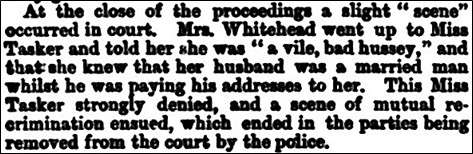 | Left: Essex Weekly News, 4 August 1871 |
| Right: Chelmsford Chronicle, 4 August 1871 | 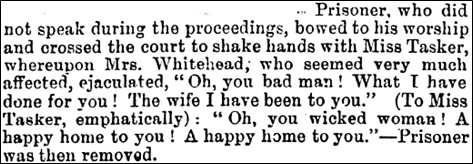 |
Back at the Police Court a week later, local residents excitedly looked on from the public benches as the salacious details of the couple's private life were revealed. There is a suggestion Maria Tasker was young and naïve, in essence fooled by the charms of an older much more experienced man. Maria told the court she knew her 'husband' was already married but he had assured her the marriage was now void by virtue of the fact he and Harriet had been apart for most of the previous year. Joseph tried to defend himself by explaining that he and his wife had not lived together as man and wife for three or four years and emphatically denied he had ever suggested to Maria that his marriage was in any way dissolved. The magistrate made it clear this did not absolve him of marrying bigamously so committed Joseph for full trial at the next County Assizes.
By the time Joseph stood trial at the Essex Winter Assizes in Chelmsford on 4 December 1871 he had been held in prison on remand for four months. It was here that the story of the failed grocery business and the resultant move to a much smaller house in Romford with the dismissal of their domestic help became a matter of public record. There is always the possibility this stressful period in their lives became a catalyst for Harriet's frailties, Joseph's aggression, and the couple's subsequent disagreements. Strangely, though, no reference was made in court of any ill treatment of Harriet by Joseph, although Harriet herself was not called to give evidence, as the law of the time was such that wives were not permitted to appear as witnesses against their husbands.
The newspaper reports suggest personal correspondence between Joseph and Harriet - undertaken during her periods of absence in London - may have been produced to the court which gave the impression he was deceiving Harriet into thinking their life was progressing in the normal way a married couple may conduct themselves whilst at the same time his affections were elsewhere.
Defence counsel put forward the assertion that Harriet effectively deserted Joseph when she received her inheritance as it had given her the opportunity to gain financial independence and stop her husband accessing her money. Harriet's sister put paid to that idea by telling the court when questioned that Harriet had handed over substantial amounts to Joseph to cover his debts.
Another of her sisters testified to Harriet and Joseph Jnr sometimes staying with her due to Joseph Snr's inability to provide financial support for his wife and child, but Joseph was welcome to visit as often as he wished. He even turned up for a visit the day after his marriage to Maria Tasker and stayed for a couple of nights and Maria confirmed to the court that Joseph left her alone at 8pm on the evening of their wedding day. She also insisted nothing improper had ever passed between her and Joseph, either before or after their wedding. In other words, she was alleging the marriage was not consummated. Instead, she called the marriage ceremony a means of rendering the "pledge of affection" made towards her by Joseph "more sacred". Maria said she had only brought the prosecution against Joseph under pressure from Harriet's brother, whereas she personally bore no ill feelings towards the defendant.
In his summing up, the judge instructed the jury that nothing was relevant apart from whether or not Joseph Whitehead had committed the illegal act of bigamy and that point had been clearly addressed in the court. The jury took just a few minutes to return a verdict of 'guilty'. When passing sentence, the judge referred to Harriet's visits to friends and family as being necessary in consequence of the family's reduced financial circumstances, the fact that Joseph knew exactly where his wife was when she was away, and his ability to visit her as frequently as he required. Despite this Joseph still chose to marry Maria Tasker, with the decision of the latter to get involved in such a marriage being a complete puzzle. Joseph was imprisoned for 12 months with hard labour.
Divorce
Within less than a year of the trial, Harriet filed her petition for a divorce on the grounds of bigamy and adultery. This is where she voiced all her allegations against her husband that she had been unable to bring to the court - his many violent acts towards her and his adultery with and subsequent marriage to Maria Tasker. Her petition was very specific as regards dates and places linked to her husband's behaviour and a newspaper report of the hearing at the divorce court commented on the wealth of documentation produced by Harriet in support of her allegations.
On balance, it seems fairly evident Maria was not being truthful in court when she said her relationship with Joseph had never been consummated. On the contrary, the disclosures at the divorce hearing give much credence to the illicit nature of that relationship. It did, after all, at the time sound rather an unlikely story. Harriet secured her Decree Finite on 11 November 1873.
The aftermath for the wives
Harriet went on to live out her life quietly, alone other than for the presence of her son. She died in 1895. Maria also went in a separate direction from Joseph; she married again in 1876 in Whitechapel, Tower Hamlets, but she didn't fare much better in this marital venture either. Within five months of the marriage to Scotsman George Walker Roy, a watchmaker, Maria had permanently returned home to her father's house having been back and forth since soon after the wedding, with the first occasion being within just a few days of the ceremony. She claimed she had become unwell because of George's ill treatment of her and on at least one occasion her father had to seek medical treatment for his daughter following an assault she had suffered at the hands of George Roy.
When Maria submitted her petition for a divorce two years later, she cited the ill treatment, violence, and numerous adulterous liaisons, including with prostitutes. George totally denied all allegations, even resorting to claiming that Maria had "condoned" any acts of cruelty that passed between them. On 17 December 1878, it was decided that as this dispute boiled down to the word of Maria against that of George Roy the case should be heard before a jury. Before the case came to court, however, in March 1879 Maria's solicitor made a representation - for which no details are included in the file - following which it was agreed the divorce petition would be dismissed. Local newspapers printed during the Autumn of that year explain exactly why….
Maria's father had died on 7 June 1878 and left an estate valued at around £6,000, a significant sum at that time. Just four days earlier, Maria had applied to the divorce court for an order against George Roy to make maintenance payments to her, formally stating to the court that she had no income of her own and, as such, was reliant upon him for financial support.
Maria understood that her father's will stipulated she should receive no income of her own until after the death of her mother. George disputed this, insisting he knew otherwise, and in September 1878 Maria was arrested and charged with perjury, with George's objective being avoidance of any financial liability towards Maria.
At the Romford Petty Sessions of October 1878, a confused story emerged (so I hope I've got it right!). George Roy insisted that George Tasker had told him his daughter Maria would receive an up-front legacy of £1,800 on his death with the main estate being shared 50/50 with her mother, whose proportion would be passed to Maria after her mother's death.
What George didn't know was that once Maria commenced divorce proceedings, George Tasker told his wife that he had called on his solicitor to discuss changing the will to protect Maria and deprive George Roy of any benefit of his money. The solicitor confirmed in court that he had indeed had a discussion along these lines with Mr Tasker. The plan was to leave everything to his widow with instructions for her to care for their daughter from the proceeds, and any funds and property remaining at the time of Mrs Tasker's death would be bequeathed to their daughter at that time. For some reason, however, the will did not get changed but Mrs Tasker and her daughter had no knowledge of this until after the will had been proved by the executors in August 1878.
The Taskers' solicitor informed George Roy's legal team at the end of August and they discussed the matter of the alimony claim being dropped but George was still not satisfied. The prosecution for perjury remained in place while George insisted on seeing the will for himself. When the executor eventually produced the will, it confirmed that the estate was being divided equally between the widow and the daughter, with no payments before January 1879, but there was no other up-front legacy of £1,800.
In accordance with the earlier discussion between the two solicitors, the claim for maintenance was dropped. The magistrate consequently refused to put the case before a jury on the grounds nobody would convict Maria on the evidence he had heard. George Roy was told if he wanted the matter to go to trial, he would have to pay any costs involved - when the case appeared in the Essex Assizes trial calendar in January 1879 the court record was marked "bill ignored".
Maria lived out the remainder of her life quietly in Smethwick near Birmingham, dying in 1930 and leaving an estate worth just over £2,000 to be managed by two executors: William Frederick Ewart Ashton, a doctor, and George Thomas Lane, retired glass worker. Ashton was a neighbour (also her doctor??) from around 1900-1905.
| Chelmsford Chronicle, 12 September 1930 | 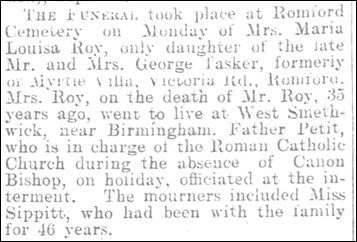 |
It was not the case that George Roy had died 35 years ago, as suggested in this news cutting. I suspect when Maria moved to live a long distance away from Romford, she chose to keep details of her messy past to herself. George Roy died in 1910 having never remarried and he, too, left an estate which was valued for probate at just under £2,500. His executor was named as Edward Ernest Papps, a tax collector.
Elizabeth Sippitt had been Maria's loyal live-in servant - and probably her companion - since before her mother had died at the beginning of 1892. I would hope she benefited in some way from Maria's money.
What Joseph Whitehead did next
Emerging from prison after having served significantly less than the prescribed 12 months, he made his way to Northampton, presumably hoping to head for obscurity. In September 1874, he married unsuspecting spinster Frances Amelia Haynes. She was in her late twenties and Joseph was now coming up to 50 years old. He told Frances he was a widower instead of disclosing his divorce or his subsequent illegal marriage. They already had a child, Arthur Edwin Haynes (but known as Arthur Whitehead) born in Northampton in the Autumn of 1872, suggesting Frances must have become pregnant very soon after Joseph's early release from prison.
Both Frances's parents had died within 10 weeks of each other when she was in her late teens and she had since lived with three of her unmarried sisters. She was probably therefore under some pressure to find a husband to achieve financial security and a respectable position in life. Once her illegitimate child was born, she was effectively trapped. Nevertheless, Joseph and Frances were married for twenty years, with Joseph returning to his work as a grocer until he died in 1893. So, this looks to have been a suitable union for both partners, although they never had any more children. Frances passed away in 1921.
Links
Ann King's notes about her Whitehead family was the starting point for Lorraine's research.
Lorraine has researched the life of an earlier bigamist with Brentford connections: Stephen Cummins Deer/Dear.
Published May 2026